
The Context Recovery Problem in Agentic Work
Modern teams lose momentum reconstructing project context. Agentic systems can help by creating source-grounded re-entry briefs and decision histories.
Field notes, implementation patterns, and pragmatic guidance for automation programs that need to survive contact with real operations.
Narrow the feed without giving the filter bar the whole stage.
Modern teams lose momentum reconstructing project context. Agentic systems can help by creating source-grounded re-entry briefs and decision histories.
Static documentation decays quickly. AI-ready organisations need living knowledge systems that are current, source-grounded, and connected to real work.
AI creates value when it changes how work gets done. The next generation of enterprise software will treat workflows as products — with users, states, feedback loops, and failure modes.
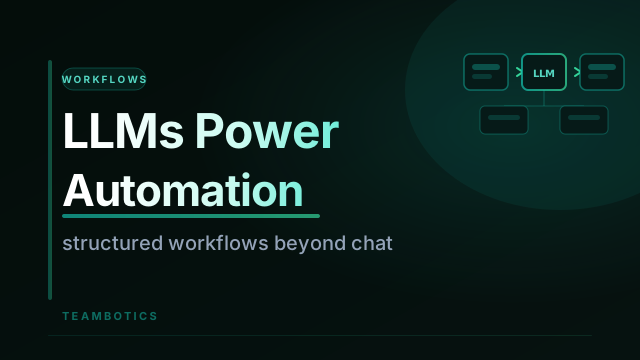
Language models are far more capable than the chat interface suggests. When combined with structured outputs, tool use, and workflow orchestration, they become the reasoning engine of serious automation systems.
Standard operating procedures are the closest thing most organisations have to a formal specification of their workflows. With careful translation, they become the instruction set for AI agents.
Single-agent AI hits real limits on complex tasks. Multi-agent architectures — where specialised AI agents work in parallel and hand off to each other — are solving problems that single models cannot.
The chatbot era is giving way to something more capable: AI agents that plan, act, and iterate without constant human guidance. Here is what that shift means for operational teams.