

Help Is a Function, Not a Destination
From F1 documentation to agentic action: why useful AI needs clear boundaries for explanation, guidance, authorization, and handoffs.
Field notes, implementation patterns, and pragmatic guidance for automation programs that need to survive contact with real operations.
Narrow the feed without giving the filter bar the whole stage.
From F1 documentation to agentic action: why useful AI needs clear boundaries for explanation, guidance, authorization, and handoffs.
%22%2F%3E%3Cpath%20d%3D%22M154.4000015258789%20123.60000610351562%20h140%20v91%20h-140%20Z%22%20fill%3D%22%23ff4db8%22%20opacity%3D%220.92%22%2F%3E%3C%2Fsvg%3E)
Search made keywords a basic digital skill. AI changes the interface again: the scarce skill is increasingly the ability to design the question, investigation, and delegation.
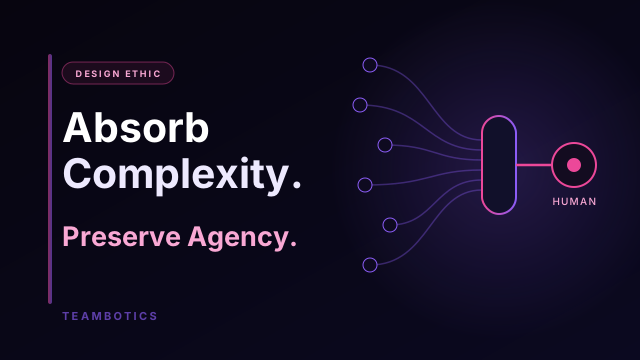
Good systems should absorb implementation complexity without quietly absorbing human authority. A Teambotics design ethic for agentic software.
Modern teams lose momentum reconstructing project context. Agentic systems can help by creating source-grounded re-entry briefs and decision histories.
Static documentation decays quickly. AI-ready organisations need living knowledge systems that are current, source-grounded, and connected to real work.
Standard operating procedures are the closest thing most organisations have to a formal specification of their workflows. With careful translation, they become the instruction set for AI agents.
Single-agent AI hits real limits on complex tasks. Multi-agent architectures — where specialised AI agents work in parallel and hand off to each other — are solving problems that single models cannot.
The chatbot era is giving way to something more capable: AI agents that plan, act, and iterate without constant human guidance. Here is what that shift means for operational teams.