
Give Every Agent the Same Map
A practical guide to building an agent-agnostic setup with canonical knowledge sources, clear onboarding, privacy boundaries, and human control.
Field notes, implementation patterns, and pragmatic guidance for automation programs that need to survive contact with real operations.
Narrow the feed without giving the filter bar the whole stage.
A practical guide to building an agent-agnostic setup with canonical knowledge sources, clear onboarding, privacy boundaries, and human control.

From F1 documentation to agentic action: why useful AI needs clear boundaries for explanation, guidance, authorization, and handoffs.
%22%2F%3E%3Cpath%20d%3D%22M154.4000015258789%20123.60000610351562%20h140%20v91%20h-140%20Z%22%20fill%3D%22%23ff4db8%22%20opacity%3D%220.92%22%2F%3E%3C%2Fsvg%3E)
Search made keywords a basic digital skill. AI changes the interface again: the scarce skill is increasingly the ability to design the question, investigation, and delegation.

Powerful AI will not be risk-free. Responsible deployment means matching safeguards, autonomy, and human capability to consequence.
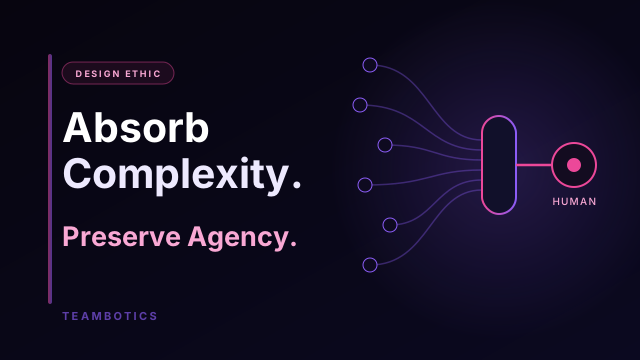
Good systems should absorb implementation complexity without quietly absorbing human authority. A Teambotics design ethic for agentic software.
Two AI operating layers tried to define a handoff between them. The result was not a working integration, but a clearer boundary around consent, provenance, authority, and evidence.
A case study in designing a multi-agent workflow around role clarity, inspectable outputs, human authority, provenance, and honest evidence boundaries.
The next useful chatbot will not only answer questions. It will help teams understand user intent, friction, feedback, and product opportunities.
We build software to take mundane digital work off a team’s plate, so people can spend more time using judgment, serving customers, and working with one another.
Modern teams lose momentum reconstructing project context. Agentic systems can help by creating source-grounded re-entry briefs and decision histories.
Open-source software is built on inheritance. A meditation on version control, the commons, and what we owe to the people who gave us the tools we build with—and what we owe to the people who will build with ours.
Business AI plans often promise that customer data is not used for model training. That matters, but it does not answer the harder question: how much can a platform still learn from your work without training on it?
Enterprise AI needs more than disclaimers. Trust must be designed through permissions, provenance, auditability, review paths, and clear accountability.
AI adoption is no longer a software decision. For executive teams, the real challenge is turning scattered AI activity into governed, measurable enterprise value.
Only 36% of employees have the training needed to use AI in their roles. The problem is not the technology—it's generic, role-agnostic training programs. Evidence-based argument for personalized, workflow-integrated learning.
Static documentation decays quickly. AI-ready organisations need living knowledge systems that are current, source-grounded, and connected to real work.
AI is most useful in care-based systems when it protects trust, access, and human capacity. The future is not automation for its own sake — it is care-based intelligence built around real service journeys.
AI creates value when it changes how work gets done. The next generation of enterprise software will treat workflows as products — with users, states, feedback loops, and failure modes.
The most durable and high-performing AI deployments are not those that eliminate the human — they are the ones that redistribute work between human and AI in ways that make both more effective.
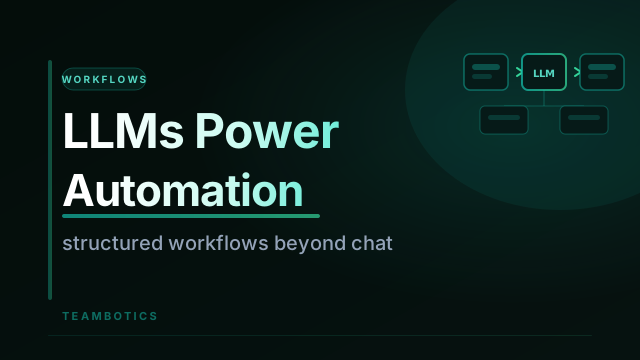
Language models are far more capable than the chat interface suggests. When combined with structured outputs, tool use, and workflow orchestration, they become the reasoning engine of serious automation systems.
The ability to communicate precisely with AI systems is fast becoming a core operational competency. Here is what that means for teams outside of software development.
Standard operating procedures are the closest thing most organisations have to a formal specification of their workflows. With careful translation, they become the instruction set for AI agents.
Before you invest in new data collection infrastructure, consider what your existing operational data is already telling you — and what it could tell you with the right retrieval layer on top.
Deploying AI in regulated industries — manufacturing, healthcare, financial services — requires a different set of non-negotiables than deploying in a startup. Here is what changes and what does not.
The highest-value AI deployments in operational environments are not those that replace workers — they are the ones that give frontline teams instant access to the knowledge and analysis they need.
Single-agent AI hits real limits on complex tasks. Multi-agent architectures — where specialised AI agents work in parallel and hand off to each other — are solving problems that single models cannot.
Most organizations already own the operational history needed to create AI value. The executive task is turning fragmented logs, notes, reports, and SOPs into governed operating intelligence.
The chatbot era is giving way to something more capable: AI agents that plan, act, and iterate without constant human guidance. Here is what that shift means for operational teams.